Technical mechanism
Dexterous manipulation combines vision, tactile sensing, proprioception and compliant control with imitation or reinforcement learning to regulate contact, force and slip.

Technology topic profile
Definition & scope
Robotics brings models into contact with people, workplaces and unpredictable environments. Progress depends on sensing, manipulation, control, safety and the ability to learn from reality.
FUURAA examines “Dexterous manipulation and touch” through its technical mechanism, deployment infrastructure, evidence requirements and public-interest consequences. This profile separates what can be demonstrated from what still requires field validation.
This is a technology and opportunity profile. It does not announce a current FUURAA product, ownership position, partnership, investment or transaction.
System map
Technical capability, enabling infrastructure, evidence and governance must be considered together.
Dexterous manipulation combines vision, tactile sensing, proprioception and compliant control with imitation or reinforcement learning to regulate contact, force and slip.
Sensors, actuators, compute, simulation, teleoperation, fleet operations, maintenance and safe work-cell design turn a robot demonstration into a service.
Testing should use varied and previously unseen objects while measuring grasp success, force precision, slip, damage and recovery from disturbed contact.
Important limitations include unstable force control, tactile-sensor drift, sparse training data, simulation-to-reality gaps and unsafe manipulation near people. System-wide governance also requires: Physical action raises requirements for fail-safe behaviour, human authority, workplace safety, liability, cybersecurity and responsible data collection.
Application contexts
Examine how “Dexterous manipulation and touch” could create measurable value in “Factories”, which supporting systems are required and where human responsibility must remain explicit.
Application contextExamine how “Dexterous manipulation and touch” could create measurable value in “Care settings”, which supporting systems are required and where human responsibility must remain explicit.
Application contextExamine how “Dexterous manipulation and touch” could create measurable value in “Mobility and logistics”, which supporting systems are required and where human responsibility must remain explicit.
Selected evidence record
FUURAA summarises and analyses; original institutions retain ownership of their work and have not reviewed or endorsed this page.
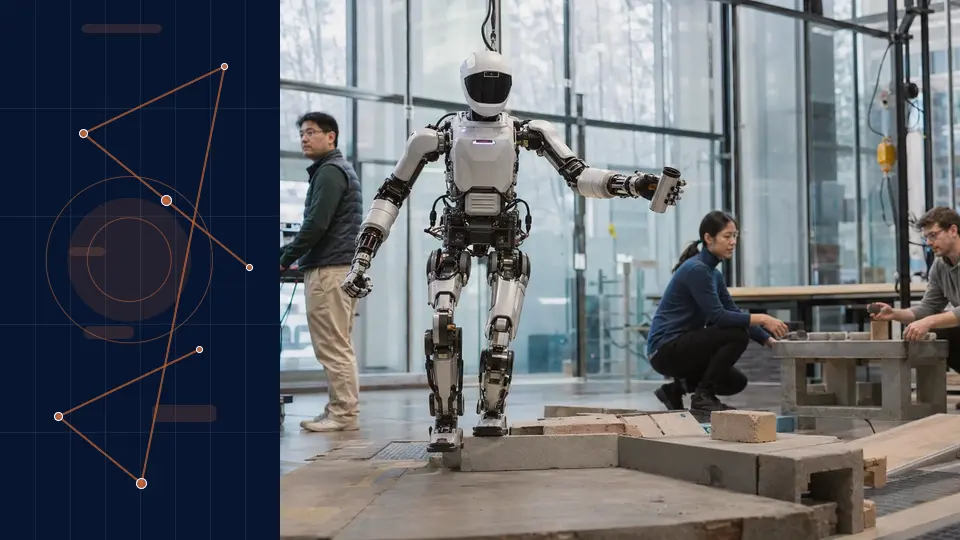
Whole-body autonomy
FUURAA synthesisFigure reports a unified visuomotor system connecting onboard sensing to walking, balancing and manipulation across a room-scale task.
Humanoid development is moving away from loosely stitched skill modules toward integrated whole-body policies.
Diligence questions
A credible technology profile should make it easier to identify evidence, dependencies, boundaries and unanswered questions.
What evidence would distinguish a controlled demonstration of “Dexterous manipulation and touch” from dependable operation?
Which technical dependency or operational bottleneck most constrains performance at scale?
Which failure or harm described in this profile should trigger suspension, escalation or human review?
Which cost, performance, safety or interoperability result would invalidate the current adoption thesis?
FUURAA outlook
Progress will depend less on isolated demonstrations and more on generalisation, dependable operations, affordable maintenance and evidence accumulated in real environments. For “Dexterous manipulation and touch”, credible progress should therefore be judged by verified outcomes, system resilience, responsible adoption and the ability to correct course—not by novelty alone.
This outlook is an editorial assessment, not a market forecast, investment recommendation or product timetable.What We Build