
Research summary · Nature
AI Is Becoming an Instrument of Scientific Discovery
The AlphaFold 3 research paper shows how AI can model interactions among proteins, nucleic acids, small molecules and other biological components—expanding AI’s role from information processing to scientific investigation.
Read the original source ↗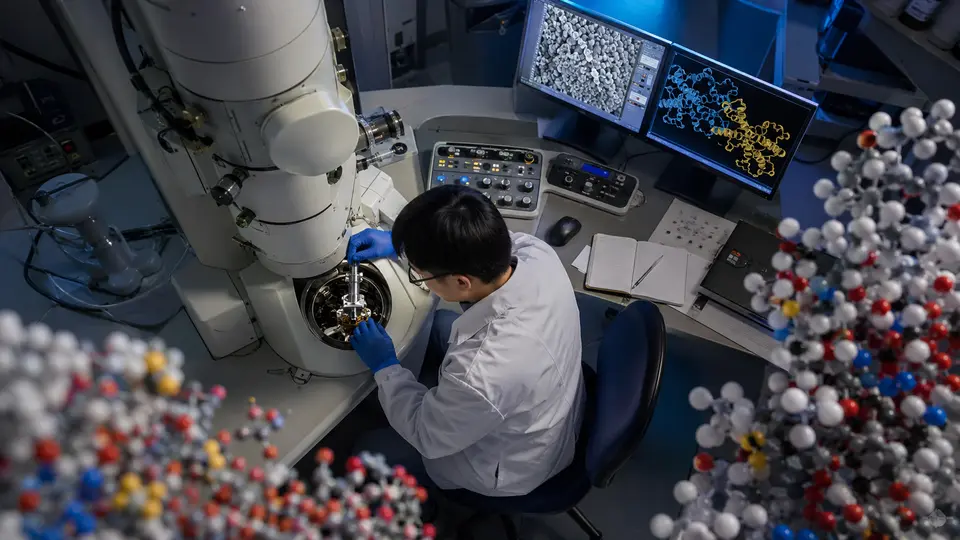 Conceptual visual
This is FUURAA’s own editorial analysis of the cited public source, prepared independently from the cited institution. Source materials remain attributable to their authors and publishers; FUURAA is responsible for their selection, synthesis and interpretation. No cited institution has reviewed or endorsed this article unless expressly stated.
External evidence
What the peer-reviewed research reports
The AlphaFold 3 paper describes a model for predicting the joint structure of complexes containing proteins, nucleic acids, small molecules, ions and modified residues. It broadens the range of biological interactions that can be modelled within one system.
The reported results improve accuracy across several interaction categories compared with specialised methods. The work illustrates how AI systems can help researchers generate structural hypotheses, while experimental validation and domain expertise remain essential.
FUURAA editorial analysis
FUURAA editorial perspective
Evidence-led analysis in the public interest
AI civilization will not be shaped only by assistants and automation. Systems that help scientists explore biology, materials, climate and medicine may become some of its most consequential public tools.
Scientific AI should be presented with disciplined boundaries: a predicted structure is evidence for investigation, not a substitute for laboratory validation, clinical review or responsible access controls.
- AlphaFold 3 demonstrates how AI can generate useful structural hypotheses across several types of biomolecular interaction, extending AI’s role in scientific investigation.
- A model prediction is not the same as experimental confirmation, clinical evidence or a complete explanation of the underlying biology.
- The wider promise of AI for science depends on reproducibility, expert judgment, access and institutions able to translate predictions into responsibly verified knowledge.
The scientific contribution is broader hypothesis generation
The peer-reviewed AlphaFold 3 paper describes a model for predicting joint structures of complexes containing proteins, nucleic acids, small molecules, ions and modified residues. It reports improved accuracy across several interaction categories compared with specialised methods. The significance is not that biological research has been automated, but that scientists may obtain structural hypotheses across a broader range of interactions within one system. FUURAA sees this as evidence that AI can function as a scientific instrument: it can help navigate a large search space and focus attention, while the meaning and reliability of any particular output remain questions for expert interpretation and further investigation.
Prediction accelerates inquiry only when its limits remain visible
A predicted structure can guide experiments, suggest relationships and help researchers prioritise scarce time. It does not replace laboratory validation, establish clinical safety or prove a biological mechanism. Models learn from available information and may perform unevenly across cases, including cases different from those represented in development and evaluation. Responsible communication should therefore state what was predicted, how confidence was assessed and what evidence would be needed next. Overstating certainty can misdirect resources; understating useful predictive evidence can also slow discovery. Scientific discipline lies in preserving the distinction while using each source of information productively.
The emerging laboratory is a human–machine system
The deeper opportunity is not a model operating in isolation, but an iterative relationship among computation, instruments, experimental evidence and expert judgment. Models can propose or rank possibilities; experiments can test them; the results can refine future questions. This description is a general inference from the role demonstrated by the paper, not a claim that one complete autonomous laboratory architecture has been established. Governance must also reflect the domain: biological and medical work may require controls over data, access and downstream use that differ from lower-consequence research. Faster cycles are valuable only when verification remains strong enough to sustain knowledge.
Public value depends on who can verify and use the knowledge
Scientific capability concentrated in a few institutions may still generate broad benefit, but access, reproducibility and independent scrutiny affect how quickly claims can be trusted and applied. Open publication can support learning, while unrestricted access to every capability may create legitimate safety or misuse concerns. These tensions should not be resolved through slogans. Institutions need transparent criteria for access, clear records of validation and cooperation between technical, scientific, ethical and public-interest expertise. FUURAA’s long-term interest in AI for science rests on this combination of ambition and evidence, not on treating model output as finished discovery.
Alternative views & uncertainty
What this evidence does not settle
- Demanding experimental confirmation before assigning any value to a prediction would misunderstand how hypotheses support science; provisional evidence can be highly useful when labelled correctly.
- Broad access may improve reproducibility and participation, while access controls can unintentionally reinforce concentration; restrictions therefore need specific justification and review.
Public-interest implications
What this means for different stakeholders
Scientific AI should be communicated in language that distinguishes prediction, validation, possible use and unresolved uncertainty.
Research programmes should connect models with experimental workflows, expert review, data governance and records of how outputs influence decisions.
Support for access and collaboration should be balanced with proportionate controls based on concrete domain risks rather than general fear of AI.
Independent replication, failure analysis and evaluation across varied interaction types remain essential to understanding where models are reliable.
What to watch next
- Whether reported model advances are followed by reproducible experimental evidence in relevant settings.
- How access arrangements affect independent scrutiny, participation and responsible downstream use.
- Whether research institutions measure acceleration by verified knowledge rather than the volume of generated hypotheses.
AlphaFold 3 illustrates a meaningful shift: AI can help formulate scientific possibilities that would otherwise be difficult to explore at scale. The achievement should be neither reduced to an ordinary software improvement nor inflated into the completion of biological discovery. Its public importance lies in a disciplined chain from prediction to expert interpretation, experiment and reproducible knowledge. FUURAA believes AI for science may become one of the most consequential dimensions of AI civilization, provided institutions preserve validation, communicate uncertainty and design access so that capability contributes to knowledge rather than merely producing more outputs.
This is FUURAA’s independent editorial analysis of the cited peer-reviewed paper. The authors, Nature and associated institutions have not reviewed or endorsed this interpretation, and no clinical or product claim is made.
Forward view
Where the wider shift could lead
Research acceleration
AI can help prioritise hypotheses and navigate scientific search spaces that are difficult to examine manually.
Human–machine laboratories
Models, instruments and expert judgment can form iterative discovery systems rather than isolated software tools.
Public value
The long-term benefit depends on access, reproducibility, safety and the ability of institutions to turn predictions into verified knowledge.
Continue reading
Related insights
1 June 2026
The Multi-Agent Future Depends on Coordination, Not Just Quantity
Stanford research reported that pairing coding agents can reduce performance, exposing coordination—not language or coding alone—as a critical bottleneck.Read insight →
11 February 2025
Global Multimodal AI Must Look Beyond Western Benchmarks
Research on vision-language pre-training at very large scale found that familiar benchmarks can saturate while culturally diverse and lower-resource tasks continue to benefit—raising important questions about what AI progress measures.Read insight →
26 July 2026