 Research Brief
AI for Science · 8 May 2024

Research domain 07
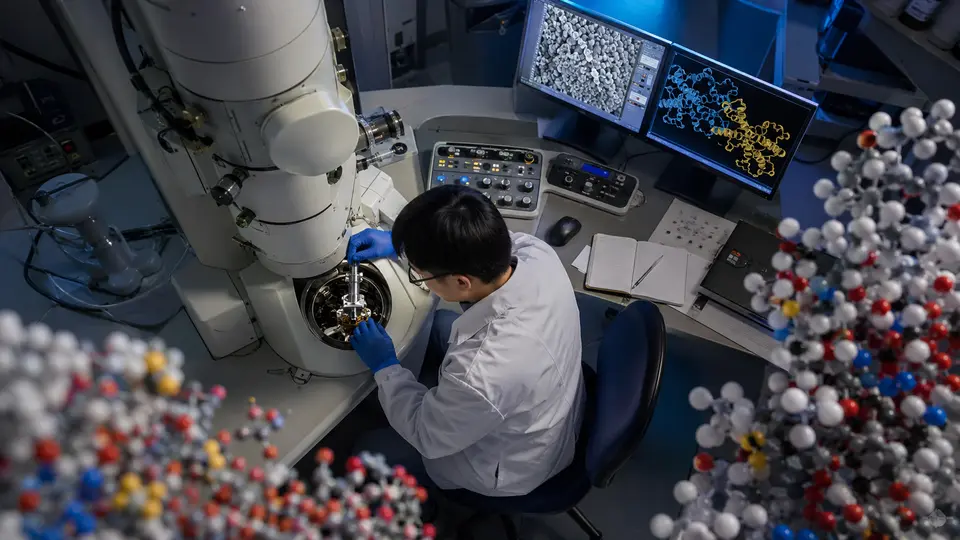
We follow AI as an instrument for mathematics, causal reasoning, simulation, hypothesis generation and scientific discovery—while studying how to preserve validity, diversity and reproducibility.
 FUURAA conceptual visual
Open research questions
When does pattern recognition become a reliable instrument for explanation and discovery?
How should AI-generated hypotheses be tested prospectively rather than celebrated retrospectively?
Can scientific agents broaden inquiry instead of concentrating attention on data-rich fields?
Reference points
These sources are independent references. Listing does not imply collaboration, approval or endorsement.
Large-scale evidence on the individual and collective effects of AI-assisted science.
Open canonical source ↗02Nature Machine IntelligenceResearch across scientific machine learning, robotics, interpretability and society.
Open canonical source ↗03Carnegie Mellon School of Computer ScienceA broad reference across theory, systems, HCI and scientific discovery.
Open canonical source ↗Related publications
Research BriefAI for Science · 8 May 2024
 Research Brief
Global AI Landscape · 2026 edition
 Research Brief
Frontier AI Safety · 3 February 2026
Live evidence radar
The benchmark separates preservation, retrieval and reasoning stages, showing that successful storage alone does not ensure correct assistance.
→Adaptive measurement reframes evaluation: not every question contributes equal information about a model. Choosing the right tests can improve estimates while reducing waste.
→AlphaEvolve shows a repeatable pattern: models propose candidate programs, objective evaluators test them, and an evolutionary loop retains better solutions. Its reported applications now span computing, mathematics, genomics, power systems and Earth science.
→The value of an algorithm-discovery agent depends on whether candidate outputs can be tested quickly, consistently and at scale. Better evaluators can turn broad model creativity into dependable experimental progress.
→Reported AlphaEvolve results include optimized procedures and candidate solutions across multiple formal domains. Because code can be executed and measured, an algorithm can serve as both a hypothesis and a testable artifact.
→The same discovery pattern has been reported in compute, quantum circuits and power-flow optimization. Small algorithmic gains can matter repeatedly when embedded in high-volume infrastructure.
→As autonomous search contributes to consequential engineering and scientific results, knowing which model, prompt, evaluator, data and human decision produced a method becomes part of its credibility.
→Stanford reports large-scale experiments in which AI assistance supported scientific review. The strongest use today is early feedback on gaps, inconsistencies and technical issues before formal submission.
→Keep the question open
Researchers, engineers, universities and public institutions may propose sources, corrections or areas for structured review.